Quality
What actually makes a hoodie worth $65.
5 min read
Most hoodie shopping happens on price alone, because there's rarely anything else to compare. Two hoodies can look almost identical in a product photo and be built from completely different fabric. So before you decide whether $65 is a lot for a hoodie or not much at all, here's what to actually check — on ours or anyone else's.
Fleece weight, in GSM
GSM (grams per square meter) is the one spec that tells you the most in the fewest words. A lot of fast-fashion hoodies sit in the 220–280 GSM range — thin enough to see light through if you hold them up. The Alora Hoodie is 450 GSM brushed fleece, close to double that. Heavier fleece drapes differently, holds its shape wash after wash, and actually keeps you warm instead of just looking warm.
The fabric blend
Ours is 80% cotton, 20% polyester. All-cotton fleece feels soft off the shelf but tends to pill and lose shape faster; all-poly fleece holds shape but can feel synthetic against skin. The 80/20 blend is a deliberate middle: cotton for the hand-feel, a fifth polyester for structure and recovery.
What's touching your skin
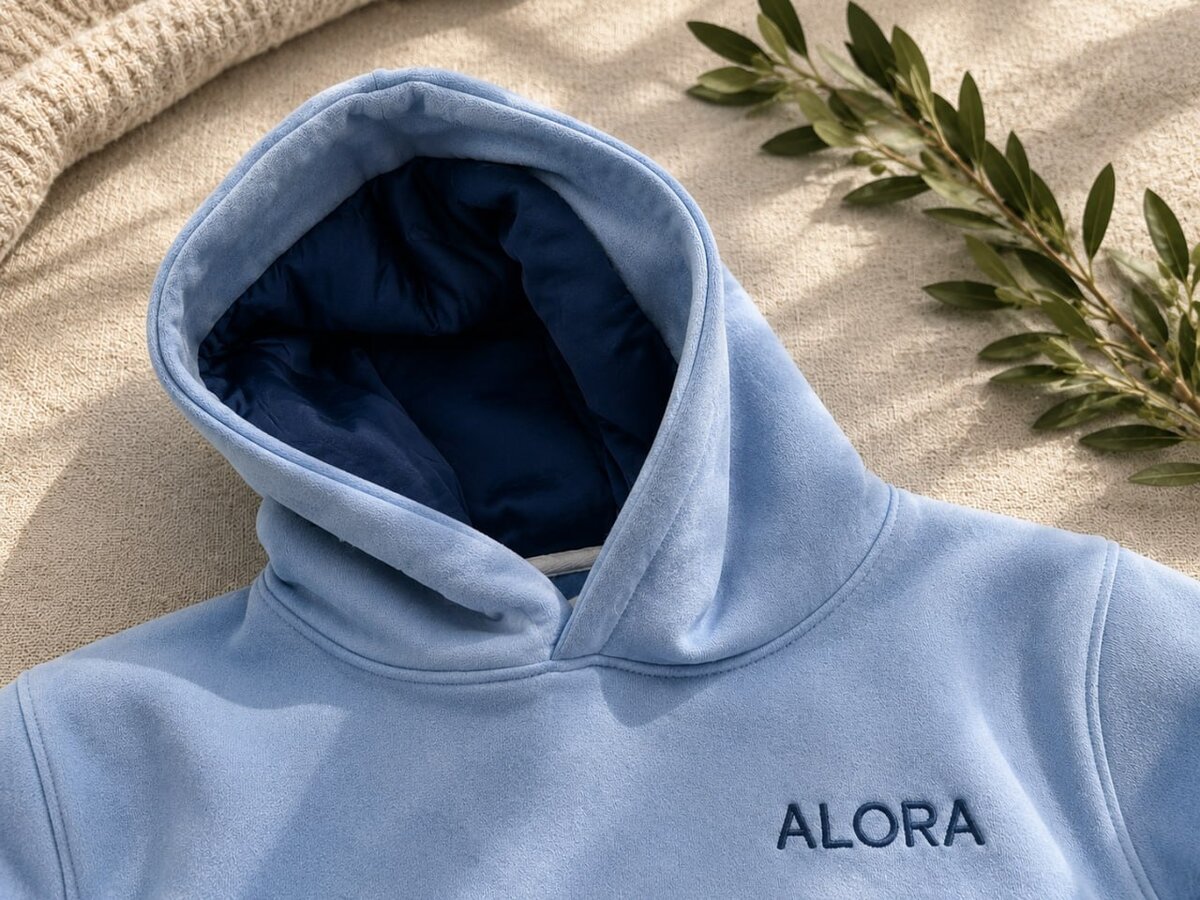
This is the part that's easy to miss in a flat product photo. Our hood is double-layered with a silk lining on the inside — the part that actually touches your face and hair when you pull it up. It's the same reasoning behind silk pillowcases, wraps, and bonnets: silk fiber is smoother than cotton or fleece, so hair glides against it instead of catching, which is why a silk pillowcase has been shown to cut hair friction by as much as 43% compared to cotton. Less friction means less of the breakage, split ends, and frizz that come from hair rubbing against a rougher fabric all day. Cotton also pulls moisture out of hair as it sits against it; silk doesn't, so it leaves your hair's natural oils and any product you've put in it where they belong instead of drying it out. It's a small detail, but it's the difference between a hood you wear because you have to and one you reach for on purpose.
The materials you can't see in a photo are usually the ones that decide whether you actually wear something.
Construction details that add up
None of these show up in a size chart, but they're why a hoodie lasts:
- Raised rubber puff-print logo at the chest and hood, not embroidery that can catch and pull loose over time.
- Double-stitched kangaroo pocket — the seam that takes the most stress from hands going in and out every day.
- Ribbed hem and dropped shoulders, built for the slightly oversized, cocoon fit rather than a fitted cut that was scaled up.
- No drawstrings — one less thing to fray, lose, or catch in a washing machine.

So is it worth it?
We're not going to pretend a $65 hoodie is the same as a $25 one — it isn't, and it shouldn't be. But we also priced it the way we did on purpose: heavier fleece and a real silk lining cost more to make than thin fleece and no lining, and $65 is what covers that without the markup you'd see from a traditional retailer. If you're comparing hoodies, GSM, fabric blend, and what's actually lining the hood are the three things worth asking about — on ours or anyone else's.
The Alora Hoodie — Sky, $65.
Shop the hoodie →